
Summer 2026 status
We are back with a monthly status after taking a break this summer.
🛡️ Security news
Recently, CryptPad has implemented a new security policy. While the security reporting process remains mainly the same as before (i.e. sending findings to security@cryptpad.org), we added several points:
- We now use the Common Vulnerability Scoring System (CVSS) score using version 4.0). This version of CVSS computation has a better granularity in defining attacker capabilities, especially in user interaction needs for mounting an attack (which was boolean in version 3, and now distinguishes between active and passive attacks).
- We specified the duration of the embargo before CVE publication (90 days after the public release including the patch).
- This security policy does not only apply to the CryptPad codebase, but also to the different repositories we are maintaining. The complete list is part of the security policy.
Last February we faced a denial of service (DoS) attack, which has been mitigated, and the fix is available in the 2026.2.1 release. Details and post-mortem has already been published in a blog post. We are also in the process of reviewing the security changes in the previous Spring release to make them public.
🎤 Pass the salt conference and post-quantum recap
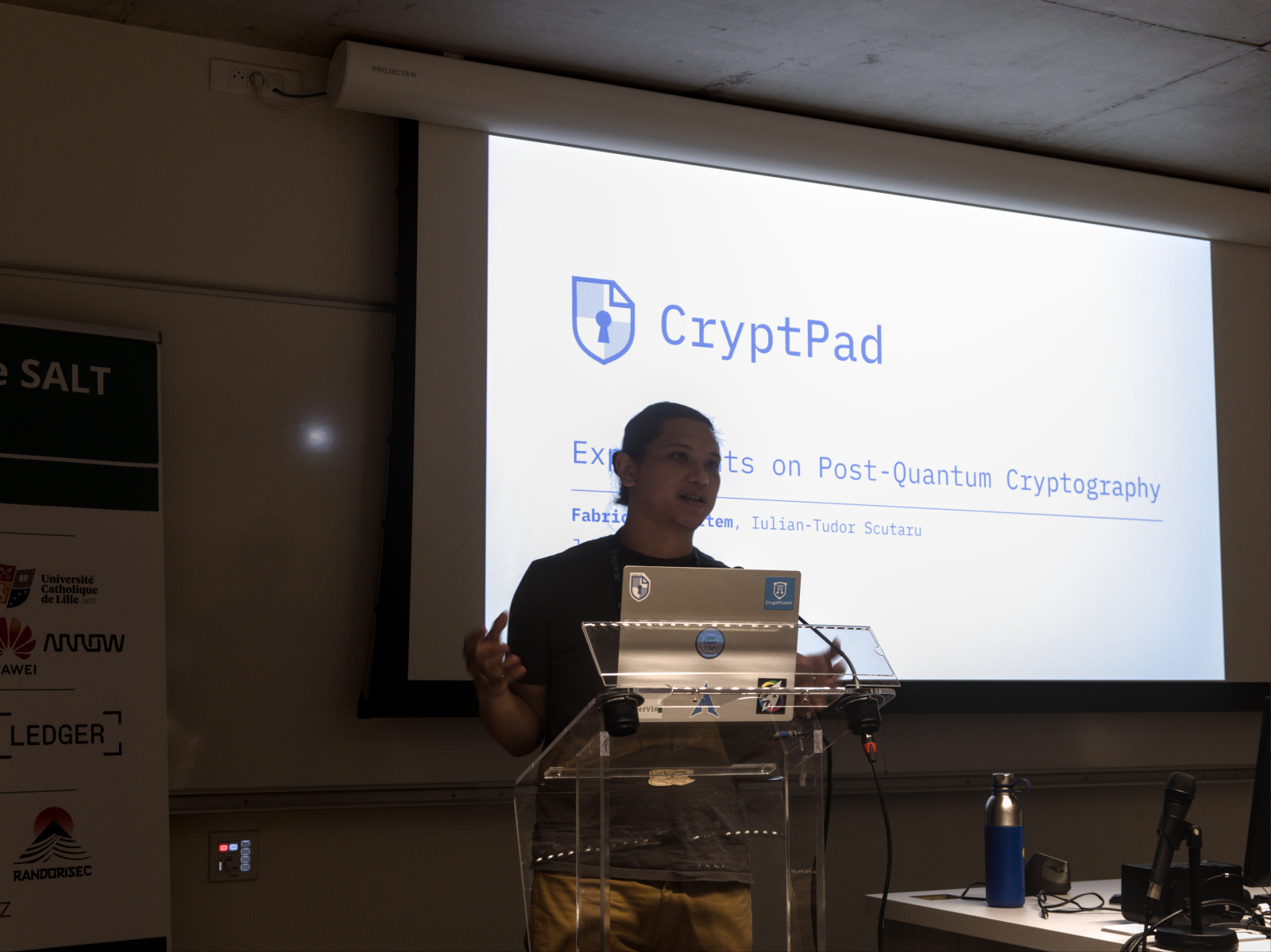 By: Julio Loayza Meneses photos@julioloayzam.com - Creative Commons BY-SA 4.0
Fabrice has presented results about post-quantum cryptographic implementation at the FOSS & Security conference Pass the Salt in Lille, France, which was joint work with Iulian‑Tudor Scutaru.
This work was summarised in the summer 2025 status blog post. The actual talk was well received, and if you missed it (or simply want to watch it again), the recording is available on Pass the Salt UBICAST channel. You can also skim through the slide deck.
To summarise this work, different post-quantum cryptography libraries
implementations and algorithms have been benchmarked to see which would have the
more fitting performance fingerprint (both in terms of computation and memory)
with our needs. These tests showed that
ML-KEM and
ML-DSA enjoy the best balance
according to CryptPad’s cryptography usage. From there, after implementing
crypto-agility practices in the CryptPad codebase, we replaced the public-key
cryptography in CryptPad code with their post-quantum equivalent (in a hybrid
manner) and faced some technical difficulties (due to the way non-interactive DH
key exchange works).
The end result of these tests was that while most of CryptPad was running
smoothly, some parts became unbearably slow due to the overhead of post-quantum
cryptography. Thanks to the discussion with experts at Pass the Salt however, we
discovered that there is a
work in progress to implement
ML-KEM and ML-DSA directly in the
Web Cryptography API. It
should be more efficient than code imported from an external library by two
orders of magnitude and may make post-quantum CryptPad a more realistic
possibility.
🆘 Support
Since Mathilde left the team, there has been a missing person in our dedicated support team. This change has two consequences:
- The first one is that we don’t have any French-speaking person in the support team, meaning that we’ll have to drop the French support on the cryptpad.fr instance;
- The other consequence is that we have a position for technical support engineer for XWiki and CryptPad. If you’re a good communicator, interested in digital privacy, and enjoy helping people protect their data, we’d love to hear from you. And if you know someone who might be a good fit, feel free to share the opportunity with them!
📰 In the news
- The environmental organization Pobles Vius has created a CryptPad tutorial in Catalan.
- CryptPad was granted the July’s project of the month from OW2!
- We are also glad to see that CryptPad was featured in a research article from the prestigious USENIX security Symposium this summer. The article “End-to-End Encrypted Collaborative Documents” from researchers from EPFL and Max Planck institute provided a formal security definition for E2EE collaborative edition and used CryptPad as an example of instanciation for their framework (see Appendix E of the paper). This piece of research received the Internet Defense Prize and an Honorable Mention.
🔭 Up next
- Stay tuned for the upcoming Autumn Release that will feature 2 releases worth of improvements!
- Most of the team will meet IRL for a week at the end of September for the yearly XWiki seminar;
- Upcoming events:
- Next month, Fabrice will be in Luxembourg for the Fair Tech Summit Europe on October 6th and the Open Source Conference on October 7th. He’ll present CryptPad as an alternative to Big Techs, from the viewpoints of both a FOSS project and as a company product.
- Then, on 14‑15 November, you can meet Fabrice again at Capitole du Libre in Toulouse, France. He’ll give an overview of CryptPad and share some of the latest developments from the project.
Links